There is something almost offensively ironic about picking up a book because you want to feel inspired to write, only to realise forty pages later that you have absolutely no idea what has happened.
This has been me recently.
I have been intentionally reaching for more books because I wanted to step away from my own manuscript for a little while, clear my head and absorb someone else’s world. I told myself it would be useful. I would notice clever dialogue, interesting pacing, character development and all the tiny things that make a novel feel impossible to put down.
Instead, I am reading entire chapters and retaining approximately three facts. Not ideal.

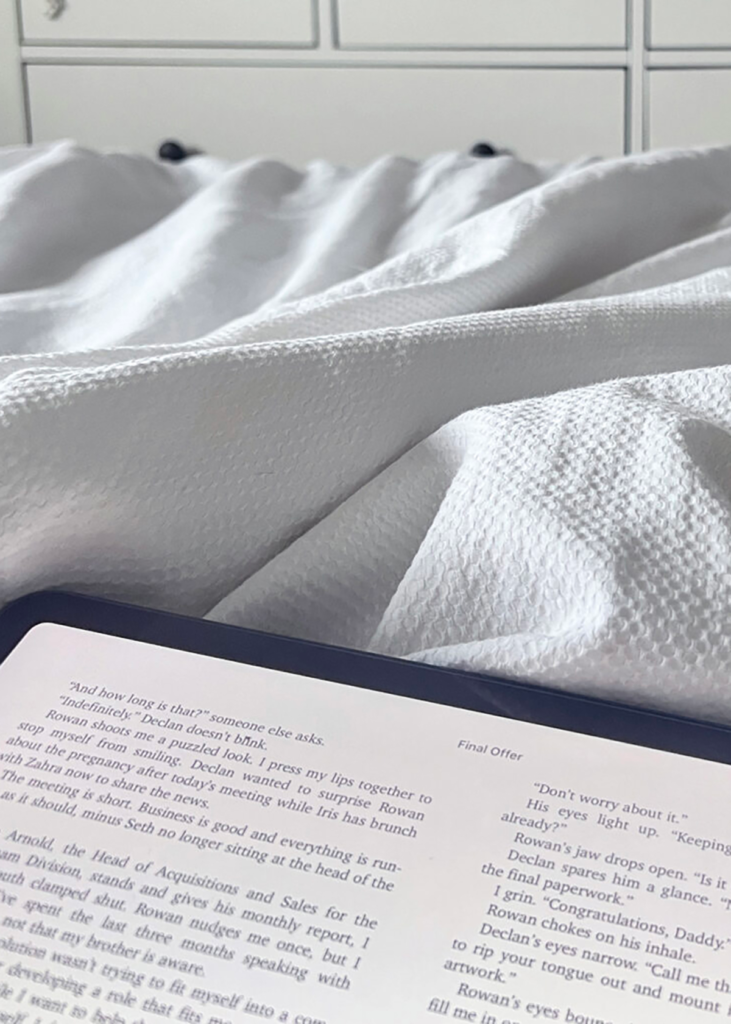
Reading for Writing Inspiration
I have always believed that reading is one of the most important things a writer can do. It exposes you to different voices, structures, genres and storytelling techniques, and it reminds you why you wanted to write in the first place.
Whenever I feel stuck with my own work, I naturally turn to books. Sometimes I want inspiration. Sometimes I need reminding that stories can still completely consume me. And sometimes I simply want to avoid Chapter Twenty-Seven for another evening while convincing myself this is technically professional development.
Usually, reading helps. Recently, however, something has felt different. I can sit down with a book, read the words and understand every sentence as it happens. Nothing feels confusing. I am following the story perfectly well in the moment. Then I close the book, walk into another room and suddenly cannot tell you what I have just read.
Characters? Vaguely familiar. Plot development? Could not say. The beautifully written passage I promised myself I would remember? Gone. Apparently, my brain has introduced a strict one-in-one-out policy and neglected to tell me.
When Your Brain Is Already Full
The more I thought about it, the more I realised that perhaps this has very little to do with the books themselves. My brain is simply full. When I am not physically writing my manuscript, part of me is still thinking about it. I am considering scenes, dialogue, character motivations and whether something I wrote three chapters ago still makes sense. Then there is work, family life, plans, responsibilities and the endless background admin that comes with being an adult.
By the time I pick up a novel in the evening, I am asking my brain to absorb another cast of characters, another fictional world and another collection of emotional problems. Frankly, she is tired. It has made me realise that there is a difference between reading when you are relaxed and reading when you are desperately trying to extract inspiration from every page. The latter turns something I love into another task.
I am no longer simply enjoying the story. I am mentally highlighting sentences, analysing dialogue and wondering why another author managed to describe something beautifully while I have used the word “looked” fourteen times in one chapter. Very restful.
Am I Reading or Am I Studying?
Reading as a writer is strange because once you begin thinking seriously about your own craft, it becomes difficult to completely switch that part of your brain off. I notice sentence structure more than I once did. I pay attention to pacing. I wonder why a particular scene made me emotional or why another one fell flat. When dialogue feels effortless, I want to understand why.
That can be incredibly valuable. But I also think I have reached a point where I am putting too much pressure on myself to turn every book into a lesson. Not everything I read needs to improve my writing.
Sometimes I should be allowed to read a ridiculous romance because I fancy the fictional man and would like to spend six hours ignoring reality. It is called having range. The irony is that when I stop trying so hard to learn from books, I probably absorb far more from them naturally. The stories that have influenced my writing most were not novels I approached with a notebook and a list of objectives. They were simply books I loved.
The lessons arrived afterwards.
Maybe This Is Creative Fatigue
I have also started wondering whether this is another version of creative burnout. Not necessarily the dramatic kind where you cannot write a single word and dramatically announce that your creativity has left you forever. More the quieter kind, where your mind is still working but everything feels slightly foggy. I can still write. I can still read. I can still generate ideas. I am simply not retaining things as sharply as I usually would.
Perhaps that is my brain telling me that inspiration is not always something I need to actively chase. Sometimes I need to give everything a little space. That might mean reading without analysing. It might mean closing the laptop earlier. It might even mean doing something completely unrelated to books, although I am not emotionally ready to consider anything too radical.
Letting Reading Be Reading Again
For now, I am trying to stop treating every book as research. If I remember a clever piece of dialogue, wonderful. If a story sparks an idea, even better. But if I finish a chapter and cannot immediately explain the symbolism behind it, nobody is coming to revoke my aspiring-author status. I want reading to feel indulgent again.
Because before I was analysing books as a writer, I was simply someone who adored them. I disappeared into fictional worlds because it was fun, comforting and occasionally far more interesting than whatever was happening in my actual life. That love of reading is part of why I wanted to write in the first place.
So perhaps the inspiration I need right now is not hidden inside a particular sentence or storytelling technique. Perhaps I simply need to enjoy the book. And if I close it and forget half of what happened? Well, at least that means I can read it again and technically get twice the value for money.


